
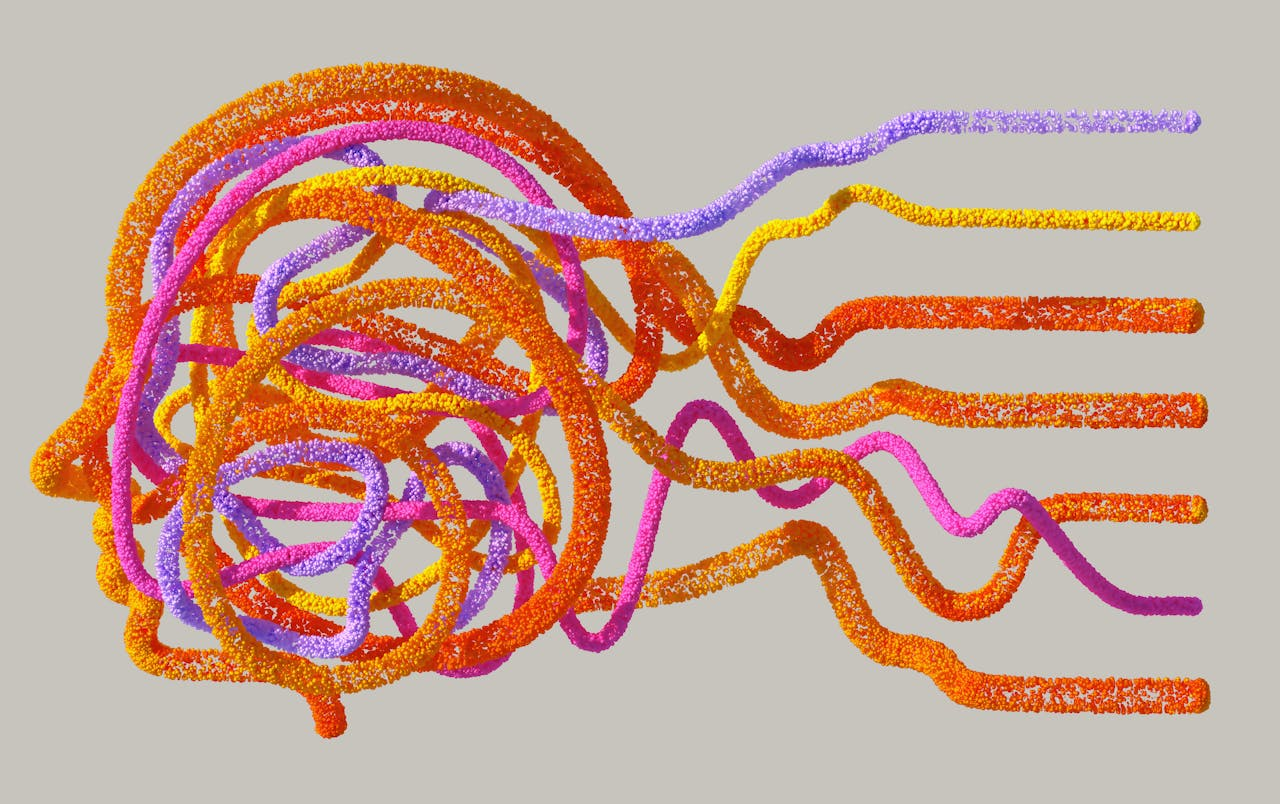
Intuition can feel impactful, wise, and even otherworldly. But what is it? Where does it come from?
Neuroscience shows that your body and subconscious mind pick up patterns long before your thinking mind catches on. That quiet tug in your chest or that sudden sense of “something’s off” isn’t random. It’s your inner‑knowing nudging you toward clarity.
When you learn to recognize that signal and pair it with conscious reflection, you unlock one of the most powerful tools for self‑understanding.
Intuition in Action: Examples of the Inner Voice Speaking
Intuition often shows up as a subtle shift in your body before your mind has words for it. You might meet someone new and feel an immediate sense of ease – or a quiet tension you can’t quite explain. Sometimes it’s the hesitation before saying yes to an opportunity that looks perfect on paper but feels slightly off. Other times it’s the sudden urge to take a different route home, only to learn later that your usual path was blocked.
Intuition can also appear as a pull toward something rather than away from it. You might feel inexplicably drawn to a job listing, a creative idea, or a conversation you weren’t planning to have. It can show up as a spark of clarity in the middle of confusion, or a sense of “this is right” long before you can articulate why. These moments don’t announce themselves loudly, but they leave an impression you can’t ignore. In each case, intuition acts like an internal compass – quiet, quick, and surprisingly accurate.
The Scientific Explanation Behind Intuition
Intuition may feel mysterious, but neuroscience shows it’s built on rapid, behind‑the‑scenes processing that happens before conscious thought kicks in. Research highlighted in The Neuroscience of Intuition: Listening to Your Gut Feelings explains that intuitive signals often arise before the conscious mind fully grasps a situation, functioning like an internal early‑warning system.
This happens because the brain is constantly scanning for patterns based on past experiences, subtle cues, and stored memories – far faster than deliberate reasoning can operate. Psychologists describe this as the brain’s ability to process information beneath conscious awareness, allowing you to “just know” something without being able to explain why immediately.
How Intuition is Represented in Myth and Culture
While there’s a neurobiological explanation for intuition, this doesn’t necessarily “demystify” it. Instead, it suggests a duality within our consciousness, an idea that was heavily discussed by the famed Swiss psychoanalyst Carl Jung. Jung also suggested that myth, folklore, and archetypes weren’t just stories, but reflections of our inner psychological landscape. Some common symbols of intuition include:
- The angel on your shoulder whispering what to do
- The voice from above speaking down to you in times of uncertainty
- A guiding star appearing in the darkness to light your path
- The daimon, described by Socrates as an inner companion that nudges you toward what’s right
- The wise elder archetype, appearing in dreams or stories as a mentor who knows more than they explain
These symbols all reflect the universal human understanding of a sacred relationship – one between our thinking mind and an older, deeper knowing beneath the surface.
Embracing the Inner-Knowing as Mind and Spirit Commune
Intuition sits in a fascinating space where science and “magic” overlap. While intuition isn’t always correct, it’s rarely random. It’s a signal worth noticing, even if it still needs to be paired with reflection, context, and conscious choice. It doesn’t mean we should act on every gut instinct, but it does mean we should observe the duality within.
At Found Self Studio, we know that finding yourself means acknowledging both the slow, analytical, calculating mind, as well as the fast, instinctive whisper that arises in key moments. When you trust that you already carry wisdom within you, you stop forcing your path and start aligning with it. That’s where real self‑improvement begins: not in becoming someone new, but in becoming someone true. What’s an example of a time when your intuition spoke to you? Share your story with us.


